Cleansers That Remove Sunscreen Without Double Cleansing
Removing sunscreen without double cleansing comes down to surfactant type and pH design, not marketing claims. Here's the science behind it.
Contents
- Not All Foam Cleansers Remove Sunscreen Equally
- Why Surfactant Type Decides Sunscreen Removal
- The pH Design Behind Gentle, Effective Cleansing
- Slightly Acidic Doesn't Automatically Mean Gentle
- When Double Cleansing Backfires for Sensitive Skin
- What This Means When You're Choosing a Cleanser
- FAQ
- Does an amino acid cleanser always remove sunscreen without double cleansing?
- Is a "pH 5.5" claim enough to guarantee a cleanser is gentle?
- Should sensitive skin still double cleanse every day?
- What's the difference between a sulfate cleanser and an amino acid cleanser for sunscreen removal?
- How do I know if my current cleanser is stripping my barrier?
Whether a cleanser can lift sunscreen off in one step or leaves residue behind isn't a matter of brand reputation — it's a matter of surfactant type and pH design. Some cleansers are built to clear sunscreen efficiently on their own; others aren't, no matter how many times you go over your face. That difference is measurable, and it's the reason "double cleanse, always" isn't a universal rule.
Not All Foam Cleansers Remove Sunscreen Equally
In late 2024, Korea's Consumer Agency tested 10 popular foam cleansers for cleansing power, user experience, and safety. Every product removed cleansing oil (makeup residue) well. Sunscreen was a different story: performance varied by product, five were rated "good," the rest only "average," and none earned the top "excellent" grade.
That gap matters. It means the question isn't "do foam cleansers remove sunscreen or not" — it's "which formulations are built to do it, and which aren't." A cleanser that struggles with sunscreen isn't a defective product; it's a product whose surfactant system wasn't designed for that job. And a cleanser that handles it well isn't a marketing claim — it's a formulation outcome you can trace back to ingredients.
Why Surfactant Type Decides Sunscreen Removal
Sunscreen filters, especially the oil-soluble UV filters used in most everyday SPF, sit in a different layer than the water-based grime a cleanser is optimized for. Lifting them off without irritating skin requires a surfactant that can emulsify oil while staying gentle on the skin barrier — and not every surfactant class does both.
Amphoteric surfactants — a category that includes amino acid–based and betaine-based surfactants — carry both a positive and negative charge on their hydrophilic head. That dual charge means their ionic behavior shifts depending on the surrounding pH: acidic, neutral, or alkaline conditions change how the molecule interacts with oil and with skin. This is also why amino acid surfactants are widely used in cosmetics — the same structural trait that lets them adapt to pH is what keeps their irritation potential comparatively low while still doing cleansing work.
In practical terms: an amino acid–based cleanser isn't automatically "weaker" than a sulfate-based one. Its cleansing behavior is tunable by formulation and pH, which is exactly the lever that decides whether it can clear an oil-soluble sunscreen filter without over-stripping the skin in the process.
The pH Design Behind Gentle, Effective Cleansing
Skin's own surface sits in a slightly acidic range, roughly pH 5.5 to 6.5. That acid mantle helps regulate the skin barrier and its resident microbes. A cleanser formulated closer to that range disrupts the barrier less than a high-pH, high-foaming alkaline cleanser, which can strip lipids more aggressively and leave skin reactive after repeated use.
This is the second half of the equation: surfactant type determines what the cleanser can remove, and pH design determines how much barrier disruption it causes while doing it. A cleanser only solves the "no double cleanse" problem if it gets both right at once — enough cleansing capacity to clear sunscreen, low enough irritation to skip a second, stripping cleanse afterward.
Slightly Acidic Doesn't Automatically Mean Gentle
It's worth being precise here, because "pH 5.5" has become a marketing shorthand that oversimplifies the formulation. As one skincare-formulation discussion notes, a slightly-acidic label doesn't guarantee mildness on its own — two cleansers at the same pH can behave very differently on sensitive skin depending on their surfactant blend, foam structure, fragrance load, rinse-off feel, and the humectants or emollients layered into the formula.
In other words, pH is a necessary data point, not a complete answer. A slightly acidic cleanser built on a harsh sulfate system with added fragrance can still irritate reactive skin, and a cleanser that lists "amino acid surfactant" on the label isn't automatically gentle if the rest of the formula fights against it. Judging a cleanser by pH number alone skips the surfactant question entirely — and the surfactant question is where sunscreen-removal capacity actually lives.
When Double Cleansing Backfires for Sensitive Skin
Double cleansing became a default routine step in K-beauty because many oil-based first cleansers pair with a foam second step, and that combination reliably clears makeup and SPF. But defaulting to it every single day has a cost for reactive skin. Community discussion among people managing sensitive skin points to a common pattern: repeating a two-step cleanse daily dries out skin and weakens the barrier over time, which can trigger more breakouts and sensitivity rather than fewer. For skin that's already easily irritated, a single, sufficiently thorough cleanse with a mild formula — followed by a proper rinse — can be the better-fitting routine than defaulting to two steps out of habit.
That's not a case against double cleansing in general; heavy, waterproof, or long-wear SPF may still call for an oil-based first step. It's a case for treating "how many cleansing steps do I need" as a formulation question tied to your cleanser and your sunscreen, not a fixed rule applied to every skin type.
What This Means When You're Choosing a Cleanser
Put the pieces together and a practical checklist emerges for anyone trying to figure out whether their single cleanse is actually doing the job:
| Check | Why it matters |
|---|---|
| Surfactant class listed on the label (amino acid, betaine, sulfate, etc.) | Determines the cleanser's baseline oil-emulsifying capacity and irritation profile |
| Formulated pH, not just "acidic" marketing language | pH shifts how amphoteric surfactants behave — but only means something alongside the surfactant type |
| Full ingredient list, not the pH number alone | Fragrance, harsh co-surfactants, or a stripping base can undercut a gentle surfactant choice |
| How skin feels after rinsing | Tightness or a squeaky-clean feel usually signals barrier stripping, regardless of pH claims |
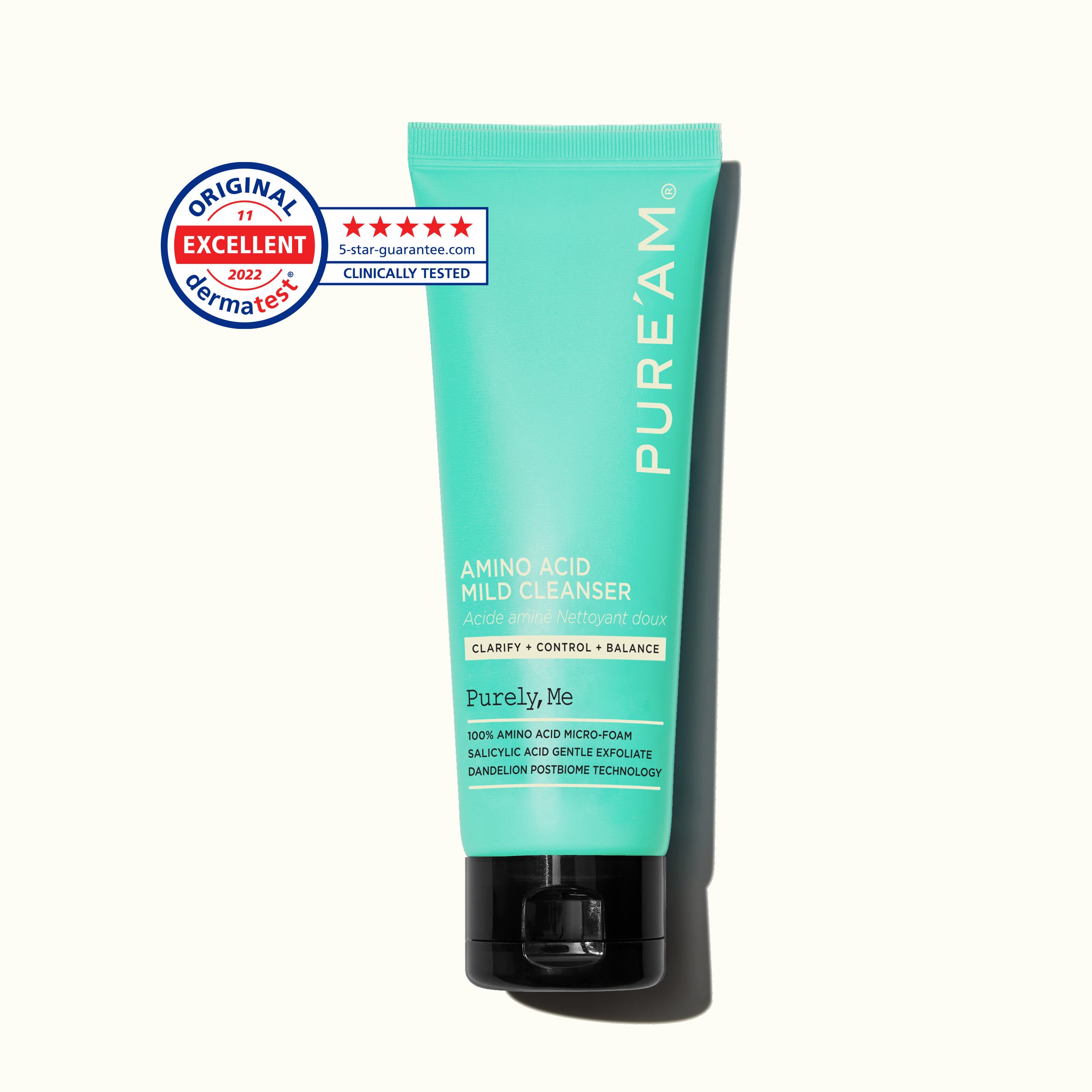
PURE'AM's AMINO ACID MILD CLEANSER is built on an amino acid surfactant base for exactly this reason — it's the surfactant class research points to as capable of both emulsifying oil and staying comparatively mild, which is the combination this whole question turns on. It's formulated as the first step in PURE'AM's cleanse-to-barrier-cream routine, designed to work alongside the brand's pH BALANCE CALMING TONER and AUTHENTIC BARRIER CREAM BALM rather than requiring a second cleansing step to compensate for it. For a fuller walkthrough of how those steps fit together, see how to build a PURE'AM routine for sensitive skin.
None of this means every amino acid cleanser removes every sunscreen without a trace, and the Consumer Agency data above is a reminder that formulation quality varies even within a single surfactant category. The reliable approach is checking surfactant type and full formulation together, not trusting a single claim on a bottle.
FAQ
Does an amino acid cleanser always remove sunscreen without double cleansing?
Not automatically. Amino acid surfactants have a comparatively mild, pH-tunable profile that supports both oil-emulsifying and low-irritation cleansing, but the rest of the formulation — additional surfactants, fragrance, and rinse-off design — still determines real-world performance. Consumer Agency testing found sunscreen-removal results varied even among cleansers people already preferred.
Is a "pH 5.5" claim enough to guarantee a cleanser is gentle?
No. Skin's natural surface pH sits around 5.5 to 6.5, so a cleanser near that range disrupts the barrier less than a high-alkaline one — but pH alone doesn't guarantee mildness. Surfactant blend, fragrance, and rinse feel all factor in.
Should sensitive skin still double cleanse every day?
Not necessarily. For skin that's already reactive, repeating a two-step cleanse daily can dry out skin and weaken the barrier over time. A single, thorough cleanse with a mild, well-formulated cleanser followed by a complete rinse may be the more sustainable option — reserving a first oil-based step for heavier or waterproof sunscreen days.
What's the difference between a sulfate cleanser and an amino acid cleanser for sunscreen removal?
The core difference is the surfactant's ionic behavior. Amphoteric surfactants like amino acid and betaine types shift charge with pH, which lets formulators tune cleansing strength against irritation potential — a balance that's harder to dial in with a single-charge sulfate system built primarily for cleansing power.
How do I know if my current cleanser is stripping my barrier?
Persistent tightness, a "squeaky clean" feel after rinsing, or increased sensitivity over weeks of use are practical signals — regardless of what the pH or surfactant label claims. If those signs show up, the formulation (not just your technique) is worth reconsidering.
Ready to rebuild your routine around a cleanser designed for this exact trade-off? Start with the AMINO ACID MILD CLEANSER.
Frequently asked questions
Does an amino acid cleanser always remove sunscreen without double cleansing?
Not automatically. Amino acid surfactants have a comparatively mild, pH-tunable profile that supports both oil-emulsifying and low-irritation cleansing, but the rest of the formulation — additional surfactants, fragrance, and rinse-off design — still determines real-world performance. [Consumer Agency testing](https://www2.korea.kr/news/policyNewsView.do?newsId=148936477&pWise=sub&pWiseSub=C2) found sunscreen-removal results varied even among cleansers people already preferred.
Is a "pH 5.5" claim enough to guarantee a cleanser is gentle?
No. Skin's natural surface pH sits around [5.5 to 6.5](https://chem-on.co.kr/Enterprise/article/%EC%BC%84%EB%AF%B8-chemi/blogart62), so a cleanser near that range disrupts the barrier less than a high-alkaline one — but [pH alone doesn't guarantee mildness](https://www.ziyega.com/board/view.php?bdId=cleansing&sno=9). Surfactant blend, fragrance, and rinse feel all factor in.
Should sensitive skin still double cleanse every day?
Not necessarily. For skin that's already reactive, [repeating a two-step cleanse daily can dry out skin and weaken the barrier](https://unpa.me/community/question/125565497) over time. A single, thorough cleanse with a mild, well-formulated cleanser followed by a complete rinse may be the more sustainable option — reserving a first oil-based step for heavier or waterproof sunscreen days.
What's the difference between a sulfate cleanser and an amino acid cleanser for sunscreen removal?
The core difference is the surfactant's ionic behavior. [Amphoteric surfactants like amino acid and betaine types](https://namu.wiki/w/%EA%B3%84%EB%A9%B4%ED%99%9C%EC%84%B1%EC%A0%9C) shift charge with pH, which lets formulators tune cleansing strength against irritation potential — a balance that's harder to dial in with a single-charge sulfate system built primarily for cleansing power.
How do I know if my current cleanser is stripping my barrier?
Persistent tightness, a "squeaky clean" feel after rinsing, or increased sensitivity over weeks of use are practical signals — regardless of what the pH or surfactant label claims. If those signs show up, the formulation (not just your technique) is worth reconsidering. Ready to rebuild your routine around a cleanser designed for this exact trade-off? Start with the [AMINO ACID MILD CLEANSER](https://www.pureambeauty.com/products/amino-acid-mild-cleanser).