Does Your Cleanser's pH Affect How Well Your Serum Works?
A high-pH cleanser disrupts skin for hours before your serum even lands. Here's the pH science behind building a cleanser-to-serum routine that works together.
Contents
- Your Serum Isn't Underperforming — Your Cleanser Might Be
- The pH Mechanism: Why Cleansing Happens Before Absorption
- What a High-pH Cleanser Actually Does to Skin
- Why Amino Acid Surfactants Behave Differently
- From Cleanser to Serum: Why Continuity, Not Just Compatibility, Matters
- Building a pH-Continuous Routine with PURE'AM
- Practical Signs Your Cleanser Is Undercutting Your Serum
- FAQ
- Does the order of pH Balance Toner and Super Glow Dew matter?
- Can a harsh cleanser undo the benefit of a good serum entirely?
- Is "amino acid cleanser" just marketing language, or a real formulation category?
- Do I need to double cleanse before using a pH-matched amino acid cleanser?
- How quickly can a cleanser change affect how a serum performs?
Your Serum Isn't Underperforming — Your Cleanser Might Be
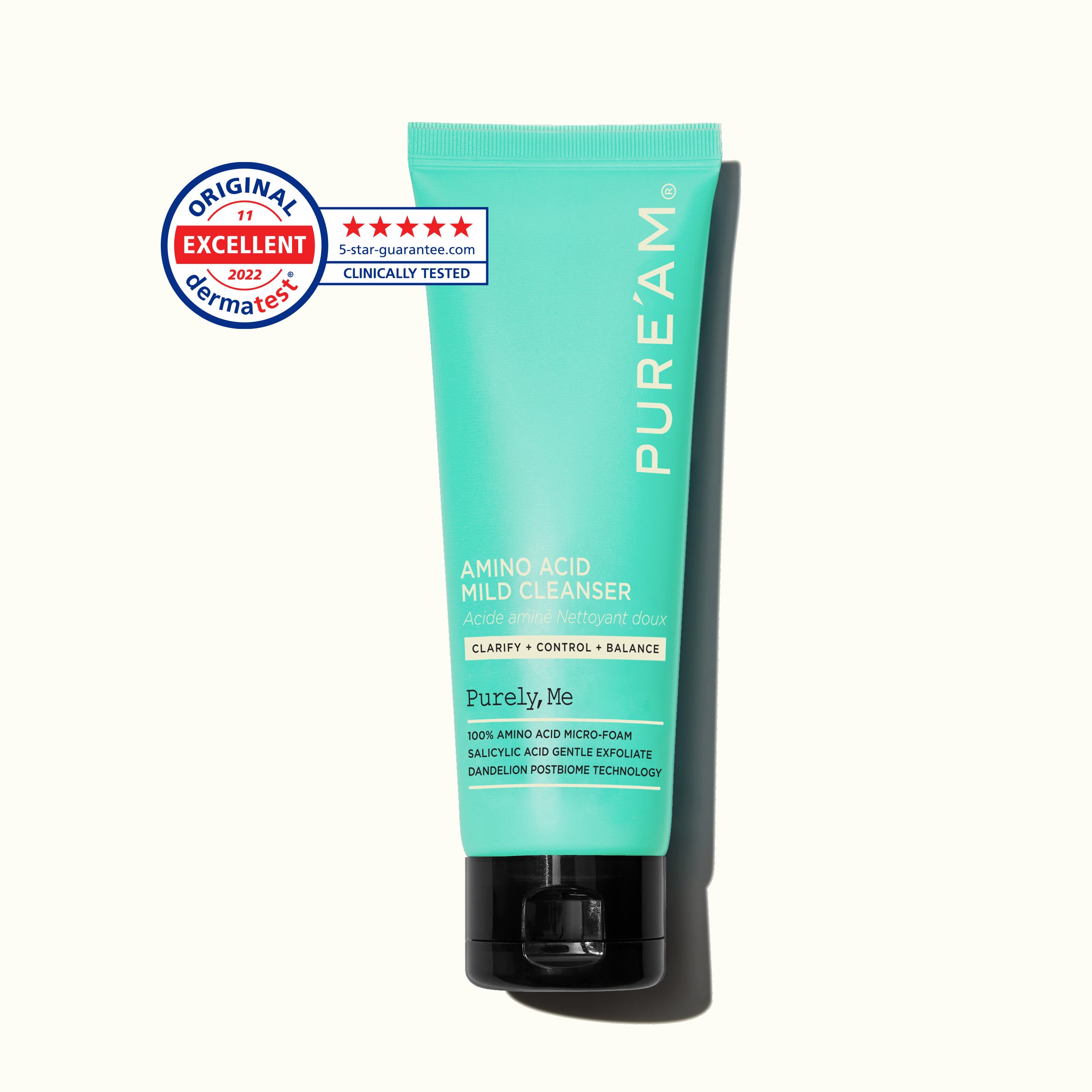
If a serum feels like it's "not absorbing" or "just sitting on top" of sensitive skin, the usual suspects — formula, dose, layering order — often aren't the real problem. The skin the serum lands on is. A cleanser that pushes skin pH too far above its natural range can leave the barrier compromised for hours, and a serum applied onto that compromised surface has less chance of doing its job. This is a formulation-sequencing problem, not just a product-quality one, and it's the logic behind pairing PURE'AM's Amino Acid Mild Cleanser with its toner and serum-step products as one continuous system rather than three separate purchases.
The pH Mechanism: Why Cleansing Happens Before Absorption
Healthy skin maintains a naturally acidic surface — the "acid mantle" — that sits around pH 4.5–5.5. This acidity isn't cosmetic trivia; it's what keeps the enzymes that hold the outer skin layer together working correctly, and what keeps the lipid matrix between skin cells intact. Clinical research backs a specific range for cleansing products too: a review of dermatologic evidence found that maintaining a product's pH in the range of 4.0–5.0 has generally been shown to be beneficial for the physiology of the epidermis and cutaneous microflora, which is the range amino-acid-based cleansers are typically formulated around.
Every step you apply after cleansing — toner, serum, cream — is applied onto whatever pH state the cleanser left behind. If that state is disrupted, the steps that follow are working against the skin instead of with it.
What a High-pH Cleanser Actually Does to Skin
The difference between a standard bar soap and a pH-matched cleanser isn't marginal. Comparative barrier-damage research cited by dermatology sources found that soap at pH 8 caused close to 10 times more skin barrier damage than a cleanser formulated at pH 5.5. That gap matters because the damage isn't limited to the moment of washing.
Harsh surfactants also don't fully rinse away. According to the same review, surfactant residue can remain embedded in the stratum corneum after rinsing, continuing to disrupt the barrier for hours after the cleansing step is technically finished. Practically, that means a serum applied "right after cleansing" isn't landing on neutral, ready skin — it's landing on skin that is still mid-disruption, with a temporarily higher surface pH and a compromised lipid barrier standing between the serum's active ingredients and the layers where they're meant to work.
Why Amino Acid Surfactants Behave Differently
Amino acid-based cleansers are formulated around a different chemistry than traditional soap-based or sulfate-heavy surfactants. Rather than stripping the surface indiscriminately, they're described as biomimetic: when the skin absorbs and metabolizes amino acid surfactants, they can provide fatty acids that help restore barrier function and amino acids that help replenish the skin's Natural Moisturizing Factor (NMF). That's a materially different outcome than a cleanser that simply removes oil and residue and leaves repair to happen on its own afterward.
This is also why amino acid cleansers are frequently recommended as a starting point for barrier-compromised or reactive skin rather than an incremental upgrade — the cleansing step itself is doing some of the repair work instead of only creating a deficit that later steps have to correct.
From Cleanser to Serum: Why Continuity, Not Just Compatibility, Matters
The connection between cleansing and serum performance isn't only theoretical. Research examining skin after cleanser-induced barrier disruption found that significant improvements in pH recovery and transepidermal water loss (TEWL) were observed after treatment application compared to an untreated control — meaning the right formula applied afterward can meaningfully accelerate recovery, but only if the skin is in a state that allows it to respond. Applying an active serum onto skin whose pH and lipid barrier are still disrupted is a fundamentally different starting condition than applying it onto skin a pH-matched cleanser has just left intact.
| Cleansing approach | Skin state immediately after | What a serum encounters |
|---|---|---|
| High-pH soap/surfactant cleanser | Barrier disrupted, surface pH elevated, residue embedded in stratum corneum | Compromised surface — serum works against ongoing disruption |
| Amino acid, pH-matched cleanser | Surface pH close to the skin's natural 4.0–5.0 range, NMF and fatty acids partially replenished | Receptive surface — serum's actives have a more stable barrier to work through |
This is the reasoning behind treating cleanser, toner, and serum-step as one designed sequence rather than independently chosen products. A serum is formulated to a target pH and delivery assumption; if the cleanser two steps earlier undoes that assumption, the mismatch shows up as "the serum isn't doing much" — even when the serum itself is fine.
Building a pH-Continuous Routine with PURE'AM
PURE'AM's current lineup is built around exactly this cleanse-to-repair sequence rather than as four unrelated SKUs:
- Amino Acid Mild Cleanser — the entry point of the routine, formulated to cleanse without pushing skin far outside its natural pH range, so the steps that follow aren't starting from a deficit.
- pH Balance Calming Toner — follows cleansing directly, positioned to support the skin's return toward its resting pH before any active step is layered on.
- Super Glow Dew — the hydration/serum step, applied once the surface is closer to its natural pH rather than immediately after a disruptive cleanse.
- Authentic Barrier Cream Balm — the barrier-sealing step that locks in whatever the toner and serum step have delivered.
This sequencing logic — cleanse gently, restore pH, then layer actives — is also the throughline of PURE'AM's existing routine-building guide, which walks through why each step is ordered the way it is for dry, reactive skin. Few routines are explicitly designed around pH continuity from cleanser through serum; most treat each product as an independent purchase rather than a linked system, which is the gap this sequencing is meant to close.
Practical Signs Your Cleanser Is Undercutting Your Serum
A few signals suggest the cleansing step, not the serum, is the source of the problem:
- Tightness or a "squeaky clean" feeling within seconds of rinsing — a sign the surface lipid layer has been stripped rather than gently cleared.
- Stinging or heightened sensitivity specifically when applying serum, but not when applying the cleanser itself — this points to a barrier left more permeable than usual.
- A serum that feels absorbed on some days and "sits on top" on others, with no change in the serum itself — often a sign the cleansing step's harshness is inconsistent (e.g., water temperature, double-cleansing frequency, or a cleanser reformulation).
None of these are proof of causation on their own, but as a pattern they point toward the cleansing step as the variable worth changing first, since it's the earliest and most controllable link in the sequence.
FAQ
Does the order of pH Balance Toner and Super Glow Dew matter?
Toner is designed to follow cleansing directly, helping the skin move back toward its resting pH before an active-forward step like a serum is applied. Applying the serum onto freshly toned, closer-to-baseline skin is different from applying it directly onto a still-disrupted post-cleanse surface.
Can a harsh cleanser undo the benefit of a good serum entirely?
Not entirely, but research on barrier disruption and recovery shows that the skin's starting condition affects how much a treatment step can accomplish — pH recovery and TEWL improvements were measurable only relative to the disrupted starting state, meaning a serum is working against a harder starting point when the cleanse before it was harsh.
Is "amino acid cleanser" just marketing language, or a real formulation category?
It refers to a real surfactant category built from amino acid-derived cleansing agents rather than soap or sulfate bases. The distinguishing claim in the literature is that these surfactants can be metabolized by skin to help resupply fatty acids and NMF rather than only removing residue.
Do I need to double cleanse before using a pH-matched amino acid cleanser?
That depends on what's being removed (heavy sunscreen or makeup generally needs an oil-based first cleanse), but the amino acid step should typically be the final one, since it's the step formulated to leave skin close to its natural pH before toner and serum follow.
How quickly can a cleanser change affect how a serum performs?
Some effects, like reduced tightness or stinging on serum application, can be noticeable within days, since they relate to surface pH and lipid disruption rather than deeper barrier repair, which research suggests takes longer and depends on the treatment applied afterward.
If your routine currently treats cleanser, toner, and serum as separate decisions, start by checking whether your cleanser sits close to skin's natural pH — everything applied afterward depends on it.
Frequently asked questions
Does the order of pH Balance Toner and Super Glow Dew matter?
Toner is designed to follow cleansing directly, helping the skin move back toward its resting pH before an active-forward step like a serum is applied. Applying the serum onto freshly toned, closer-to-baseline skin is different from applying it directly onto a still-disrupted post-cleanse surface.
Can a harsh cleanser undo the benefit of a good serum entirely?
Not entirely, but research on barrier disruption and recovery shows that the skin's starting condition affects how much a treatment step can accomplish — [pH recovery and TEWL improvements were measurable only relative to the disrupted starting state](https://www.ncbi.nlm.nih.gov/pmc/articles/PMC12048826/), meaning a serum is working against a harder starting point when the cleanse before it was harsh.
Is "amino acid cleanser" just marketing language, or a real formulation category?
It refers to a real surfactant category built from amino acid-derived cleansing agents rather than soap or sulfate bases. The distinguishing claim in the literature is that [these surfactants can be metabolized by skin to help resupply fatty acids and NMF](https://www.bioderma.co.uk/your-skin/sensitive-skin/how-amino-acids-help-cleanse-and-protect-sensitive-skin) rather than only removing residue.
Do I need to double cleanse before using a pH-matched amino acid cleanser?
That depends on what's being removed (heavy sunscreen or makeup generally needs an oil-based first cleanse), but the amino acid step should typically be the final one, since it's the step formulated to leave skin close to its natural pH before toner and serum follow.
How quickly can a cleanser change affect how a serum performs?
Some effects, like reduced tightness or stinging on serum application, can be noticeable within days, since they relate to surface pH and lipid disruption rather than deeper barrier repair, which research suggests [takes longer and depends on the treatment applied afterward](https://www.ncbi.nlm.nih.gov/pmc/articles/PMC12048826/). If your routine currently treats cleanser, toner, and serum as separate decisions, start by checking whether your cleanser sits close to skin's natural pH — everything applied afterward depends on it.